
With ETCS being rolled out on several suburban networks, Australia has adopted it as the technology pathway for national interoperability in widely differing applications. A regulatory structure has been agreed, while the use of common standards is expected to reduce the need for compatibility testing, as Frank Heibel* explains.
As a continent in its own right, Australia is one of the most substantial ETCS markets outside the European Union. However, it is also a federation in which the states own, fund and procure their railway systems, although railway safety is regulated nationally. That split leaves Australia facing similar ETCS co-ordination problems to Europe, albeit inside a single country.
The 2026 ERTMS Work Plan prepared by EU Co-ordinator Matthias Ruete lists Australia as having adopted ETCS as its standard for national interoperability. ETCS has indeed been agreed upon as the technology pathway for Australia’s National Network for Interoperability, and any digital train control system introduced on that network must comply with Australian ETCS mandatory standards.
However, there is still much to do. What stands between that decision and achieving an interoperable reality is the subject of this article, which may be instructive to anyone looking to deploy ETCS without the legislative mandate found in Europe.
The ETCS journey to date
As with so many safety initiatives in rail, Australia’s ETCS story was triggered by an accident. In 2003, a passenger train with an incapacitated driver derailed near Waterfall, south of Sydney, as it ran into a 60 km/h curve at 117 km/h, resulting in seven fatalities and several injuries. The following investigation recommended the introduction of Automatic Train Protection, and ETCS Level 1 was selected as the most suitable option at the time.
New South Wales today has rolled out ETCS Level 1 Limited Supervision across the Sydney suburban network. It has also started introducing Level 2 using two different trackside suppliers in parallel. The suburban train fleet has been fitted with ETCS from two different suppliers, and two more suppliers are fitting ETCS on the new train fleets being procured to work the regional and inter-city services radiating out of Sydney.

Elsewhere, South Australia has completed a full rollout of Level 1 for train protection on the suburban network in Adelaide. In South East Queensland, the area surrounding Brisbane, ETCS Level 1 has been introduced on parts of the North Coast Line. Within Brisbane itself, Level 2 is being piloted on the Shorncliffe Line before being deployed on the state’s flagship Cross River Rail project. Further Level 2 installations are planned for the corridor connecting Cross River Rail to the Gold Coast. And ETCS Level 2 will be installed on the new line to the Sunshine Coast, which branches off the North Coast Line inside the Level 1-fitted area.

The ETCS story in Australia to date would be incomplete without mentioning some solutions for mining railways that are based on Level 2 but include features outside the European standards. Aurizon has rolled out standard ETCS Level 2 over a non-standard TETRA radio bearer on some 2 000 km of its Central Queensland Coal Network. Rio Tinto’s famous AutoHaul project featuring driverless ore trains (what they dubbed ‘the world’s largest robot’) is based on a customised version of Level 2. Also in the Pilbara region, the Roy Hill mining railway uses a variant of the AutoHaul solution without the driverless feature. Two applications that are distinctly different from European mainstream ETCS.

Further plans for ETCS
Sydney and Brisbane are planning to continue their rollout of ETCS Level 2 with various capacity-optimising features, including cab signalling without lineside signals and probably Automatic Train Operation. Melbourne may follow a similar path, despite having adopted CBTC technology for the cross-city Metro Tunnel project, as ETCS may better suit a wider rollout across Victoria’s interconnected corridors and the requirements for interoperability with trains from other operators.
The interstate network connecting the major cities is mostly used for freight transport and plays a vital role for Australia’s economy. ETCS was long considered unaffordable for this network, but its adoption is now deemed necessary as the centrepiece of the Australian pursuit of interoperability.
National Rail Action Plan
Overseen by the National Transport Commission, the National Rail Action Plan is the umbrella initiative for improving the productivity of Australia’s rail transport. A key element of the plan is ensuring interoperable digital technology, addressing concerns about several self-controlled rail jurisdictions introducing potentially incompatible Automatic Train Protection systems.
The first step was to consider where interoperability is genuinely needed in Australia. That led to the definition of the National Network for Interoperability, which identifies those freight and passenger corridors that are deemed critical for national connectivity. In that respect the NNI is comparable to the European TEN-T core network as the sub-network that connects the most important urban nodes, ports, and crossing points between different jurisdictions. The NNI deliberately excludes parts of the interconnected Australian rail network where interoperability might not be absolutely necessary and economically unjustified. Figs 1 and 2 compare the NNI with the operational footprint of one major Australian rail freight operator, illustrating the principal differences.
Alongside the definition of the NNI, a ‘Memorandum of Cooperation’ was signed progressively by all of the Australian governments, the Australasian Railway Association, rail infrastructure managers, rolling stock operators and interested suppliers and consultancies. This committed all of the signatories to consider national rail interoperability ahead of any future investment.
In August 2025 the federal and state ministers for infrastructure and transport agreed on ETCS as the technology pathway for the NNI. The most important consequence of this decision is ensuring the technological alignment of the all-connecting interstate network with what has already been introduced or is being planned in most of the major cities.
Not quite like Europe
In Europe, the EU member states are bound to implementing ETCS as interoperable train control technology by European law, along with the Control Command & Signalling Technical Specification for Interoperability. In the absence of an equivalent legislative mandate in Australia, the MoC was needed to bind all relevant parties, notably including the state and territory jurisdictions.
Thus the mandate in Australia is regulatory rather than legislative. Australia’s Rail Safety National Law regulations were recently amended and now require operators to consider national interoperability and manage identified interoperability matters when planning changes to their operations.
Europe established the EU Agency for Railways as the system authority for ERTMS. Australia does not have an equivalent to ERA because of the different statutory structure. The intention is to distribute the various ERA-equivalent roles between three parties: the National Transport Commission, which oversees the NRAP, the Australian Rail Industry Standards Organisation and the Office of the National Rail Safety Regulator. With the only Australian interoperability mandate being regulatory, the regulator ONRSR appears to be the only party that can have an enforcement role. Separating that role from the standing of an ERA-like system authority for ETCS is an experiment where the outcome is hard to predict and impossible to guarantee.
What could favour Australia is that Europe needed ETCS to harmonise retrospectively and eventually replace numerous incompatible national legacy systems for train protection. Australia, by contrast, is introducing train protection for the first time on almost the entire NNI. That means it should be possible to prevent the incompatibility of train protection systems from the outset, rather than having to repair it later.
Common to both Europe and Australia is that the prospective business benefits of ETCS are mostly in favour of infrastructure managers; this makes it difficult to motivate private rolling stock operators to equip their fleets. Australia’s urban and suburban rail networks are vertically integrated and do not have that problem, but the fitment of the large fleet of privately owned locomotives that operate on the interstate network and regularly cross into urban parts of the NNI will be a major task within the overall Australian ETCS rollout.
Urban and non-urban
Before looking at the Australian approach to achieve interoperability in practice, it is worth clarifying the characteristics of the country’s two different ETCS application categories. ‘Urban ETCS’ covers the installations that are evolving in the city networks of Sydney, Brisbane and potentially Melbourne. These are all Level 2 applications that need to fit the label High Capacity Signalling as assigned to all three programmes by Infrastructure Australia. A critical element to achieve that is the widespread removal of lineside signals, which allows the optimisation of block sections for capacity instead of merely avoiding signal sighting constraints.
The adoption of cab signalling without signals requires full fitment of the fleet with ETCS. That is manageable for the state-owned train fleets used on the respective urban services, but much more difficult to co-ordinate with the retrofitting schedule for those interstate locomotives that operate over parts of the city networks. Retaining secondary signalling with an ETCS overlay is unavoidable during the fleet migration period, leading to mixed operation of ETCS-fitted and unfitted trains, but this will defer the full benefits of the investment until the lineside signalling is removed. The capacity target for Urban ETCS is up to 24 trains/h, which is at the upper limit of current ETCS references in Europe. Achieving it will require the railways and their suppliers to stretch the limits of capacity achievable with ETCS.
By contrast, the interstate network will require ‘Non-Urban ETCS’. That is a collective term for a wide spectrum of scalable applications that need to suit very diverse operational environments, including some of the most remote and inaccessible territories imaginable. To give a perspective of the vastness of some interstate corridors, the NNI spur line from Tarcoola to Darwin is equivalent to the distance from Lisboa to Warszawa. It is mostly single track with very occasional passing loops; the traffic density is about six trains in each direction — per week, not per hour.
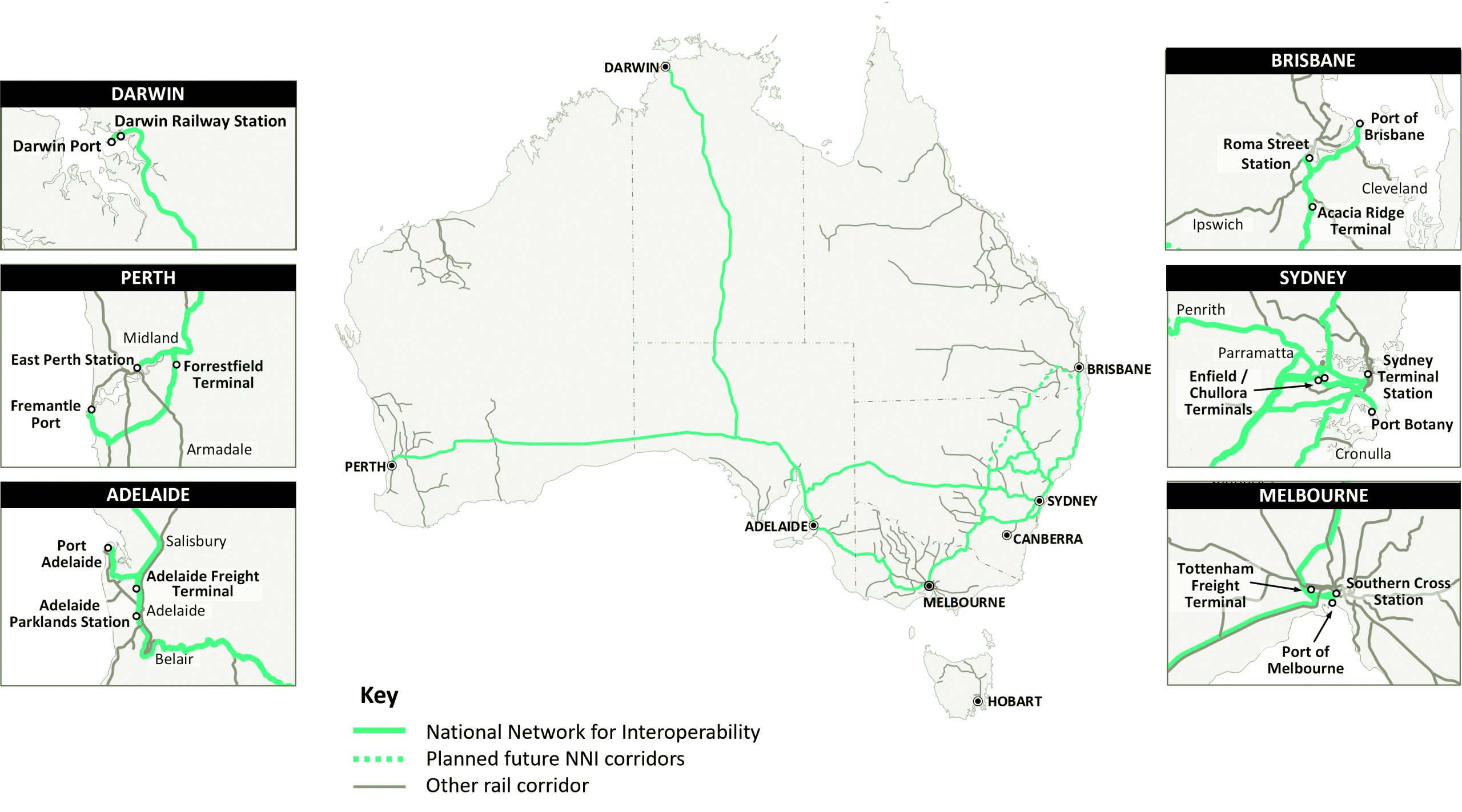
Previous doubts about ETCS affordability on the interstate network have not been forgotten. Even though ETCS is now the agreed technology, its affordability will determine the motivation for a swift rollout over a finite amount of time. The full benefits of ETCS can only be realised when both corridors and fleet are fully fitted, and experience in Europe shows how economically unattractive is the long-term coexistence of ETCS and legacy signalling.
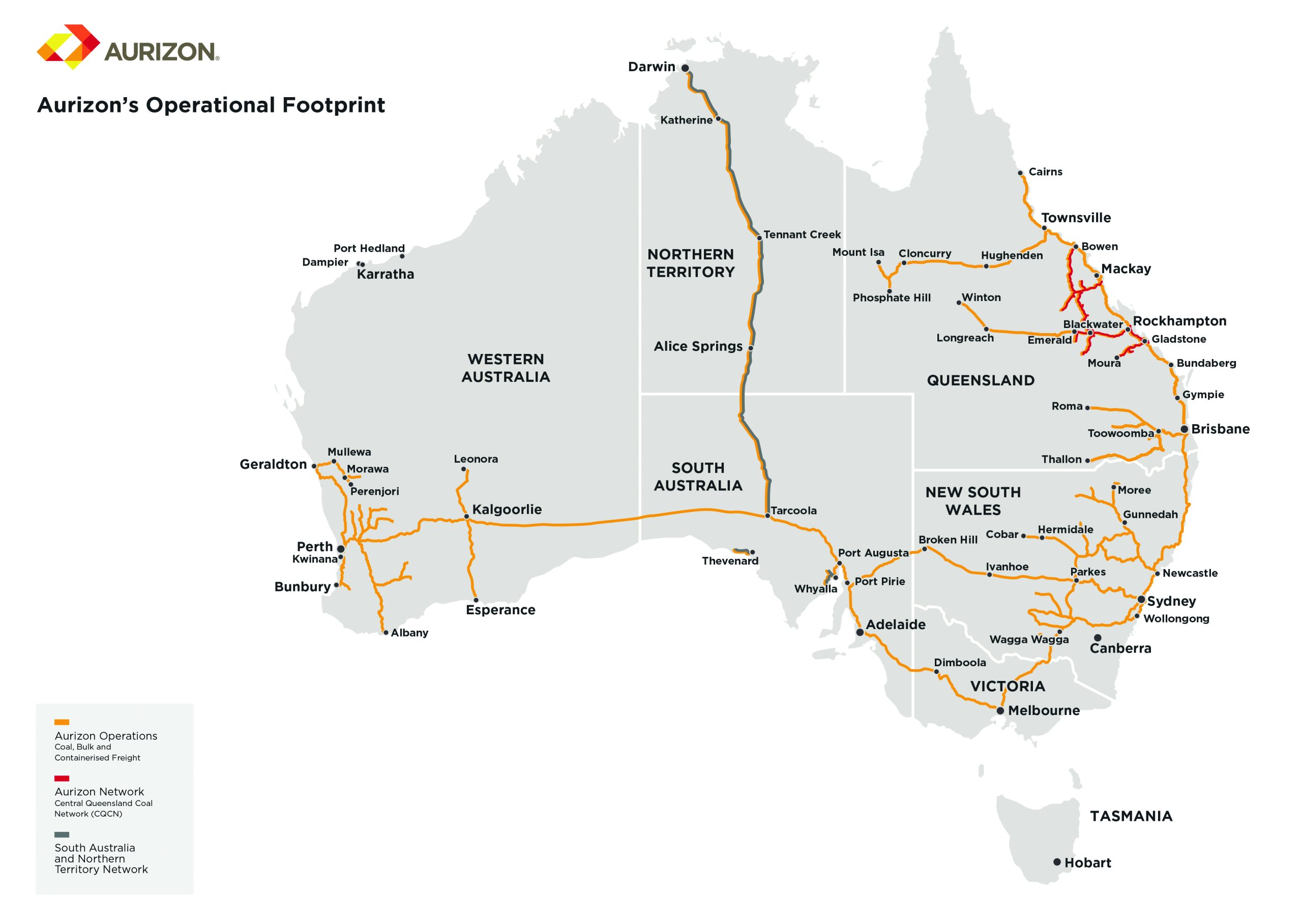
Aurizon.
It remains to be seen what exactly a scalable and affordable Non-Urban ETCS solution may look like in detail. This development will take ETCS suppliers into areas of application they will have very rarely encountered in Europe. Some functional combinations from the toolbox that ETCS provides could be rare or even novel, which will redefine the compatibility requirements for the onboard ETCS on locomotives, apart from having to operate on Urban ETCS in the cities. Which leads to an interesting challenge for what Australia plans to do.
Pursuing ETCS interoperability
The toolbox of ETCS functions mostly originated from the desire to replicate the behaviour of all the different legacy train protection systems in Europe, but these could be useful for solving specific problems in Australia, including maybe some of those Non-Urban ETCS functions. But if every project draws on that toolbox freely without any constraint, the result will likely be what the Managing Director of the ERTMS Users Group Sverre Kjenne recently described as a ‘jungle of versions’.
While this would require onerous retrospective repair in Europe or present interoperability challenges that drive up ETCS project costs, Australia set out to constrain the risk as early as possible. This was done by means of setting mandatory standards: one for trackside ETCS and one for the onboard units.
This does not mean that Australia is developing its own version of the ETCS standards in parallel with Europe. Rather, it wants to prescribe which parts of the European specifications are applicable and should be used, and which are not. The extent of the ambition is clear from the vision for those two standards. Full compliance of trackside and onboard ETCS with their respective mandatory standards is meant to make compatibility testing between the subsystems all but superfluous. Interoperability will be achieved by compliance, if it all goes to plan.
This approach still raises several questions. How can the compliance of a local ETCS trackside specification with the mandatory standard be verified? By whom? And what happens if a non-compliance is identified? The same three questions are repeated for the onboard side. And then the culmination is question seven. What happens if the trackside and onboard systems were deemed compliant with the standard, but interoperability gaps are found in residual tests, or worse, during operation?
These questions are not just about responsibility or capability. The underlying question is how standards compliance can be proven reliably, objectively, repeatedly and with results that are accepted by all of the parties involved, even by those facing rework. In a way, this problem requires the same two functions provided by ETCS:
- Supervising compliance (with the mandatory standard, not the permitted speed profile);
- Enforcing compliance (adequate intervention when standard compliance, or speed profile, gets violated).
Let’s start with the hard part, enforcement. With the distribution of responsibilities presently emerging in Australia, the regulator ONRSR is the only party with any enforcement lever, namely the interoperability provisions of the Rail Safety National Law. However, that means that ONRSR must be willing to tell a high-profile metropolitan mega-project to go back and design out a non-compliance even if it costs a lot of money.
Crucially, in the worst case, that could delay the ribbon-cutting opening date for the entire project. That does require some courage, and any demand had better be grounded on watertight proof of any non-compliance. Which leads to the supervising task, or rather the verification of compliance.
Testing key to interoperability
For the Australian approach to work, the trackside specification of an ETCS project needs to be tested for conformance with the mandatory trackside standard. In the case where there are several trackside specifications within the same jurisdiction, those need to be tested for coherence. And the ETCS trackside products from the respective suppliers then need to be tested for compliance with the standard-conformant specification.
Similarly, the onboard specification needs testing for conformance with the mandatory onboard standard. And each supplier’s onboard product needs testing for compliance with its specification.
That should be all, as per the aspiration for the mandatory standards in Australia. But as Stephen Lemon, Executive Director of Rail Systems & Operations Reform for the NTC, has observed, ‘even with the standards doing their job, some compatibility testing is likely to remain. Doing it once in one place is better than every jurisdiction maintaining a capability long after its own project has finished.’
So realistically, compatibility testing comes on top of the testing steps listed above. Ideally, it should be done as early as possible. Not product against product in the field, but as a standard-compliant onboard specification against a standard-compliant trackside specification offline in a simulation test laboratory. Finding any gaps as early as possible means that finished products can be genuinely finished rather than needing to be debugged in service.
The second part of what Stephen Lemon said is just as important. Independent testing in one vendor-neutral and operator-neutral place should deliver comparable test results that all parties can trust, and that ONRSR could rely on for its assessments. Reliably and with solid standing, even in front of that mega project from the earlier scenario.
Takeaway for other markets
Australia offers a case study in how to pursue an interoperable national ETCS rollout without a legislative mandate or the concentrated powers of an agency like ERA. The country is building the necessary governance structures, standards and assurance framework while the first deployments are already underway.
This is a different way of pursuing interoperability from what is being done in most of Europe, and it remains to be seen if that different way turns out to be more effective. Whatever the outcome, the comparison between the European and Australian approaches will be instructive for any ETCS market with similar conditions.
Source: rg


