INDIA: Bengaluru’s Namma Metro network reached 104 km with the opening of the first section of the Pink Line at 06.00 on November 14. Prime Minister Narendra Modi used a cricket metaphor at the ceremonial inauguration the previous day, saying Bengaluru had become the third city after Delhi and Mumbai ‘where the metro network has achieved a century.’
Pink Line
The elevated first stage of the Pink Line runs for 7.5 km in the south of the city, linking the terminus at Kalena Agrahara with Suddagunte Palya (originally to be named Tavarekere). The line has six stations, including an interchange to the Yellow Line at Jayadeva Hospital.
Designated as the Reach 6 Priority Section in the city’s metro expansion programme, the new line has been completed at a cost of Rs34.7bn.
Services are initially running every 8 min using four six-car trainsets, with one set available in reserve. The operator plans to increase the frequency according to demand.
‘Ease of living and ease of travel’

The Prime Minister said the new metro corridor would significantly improve connectivity to the Indian Institute of Management, numerous educational institutions and major business, technology and commercial hubs across the city. Hundreds of thousands of people would ‘not only have convenience in commuting’ but would ‘also be able to save their money and time’, he believed.
Average weekday ridership on the Namma Metro network is around 916 000 passengers, and the new line is expected to take daily patronage above one million. Modi said the success of the Namma Metro was ‘the result of the country’s new thinking regarding ease of living and ease of travel, and the outcome of the country’s commitment to make the lives of middle class families better’.
The next section of the Pink Line is scheduled to open in 2027. This will run underground for 13.8 km north from Suddagunte Palya through the city centre to Nagawara. This will add a further 12 stations including interchanges with the Purple Line at MG Road and the planned Blue Line at Nagawara.
BEML rolling stock

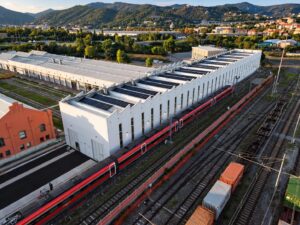
BEML has supplied the domestically-designed stainless steel-bodied trainsets, which have been built at its plant in the city, and will also provide 15 years of maintenance support. A fleet of 23 six-car trainsets has been ordered for the full Pink Line.
The trains have a design speed of 90 km/h, although the operating speed is limited to 80 km/h; each train can accommodate up to 2 008 passengers. Features include wide inter-car gangways, air-conditioning, USB charging, dynamic LCD route maps, passenger information and CCTV systems.
Alstom signalling
Alstom has supplied its Urbalis communications-based train control, platform screen doors and the Urbalis Vision platform for monitoring and managing train operations from the control centre at Baiyappanahalli in the east of the city. Alstom’s HealthHub provides real-time condition monitoring of the signalling assets.
The trains and signalling system have been designed to support unattended GoA4 operation, although the services are initially operating under GoA2, with automated traction and braking supervised by a driver on board.
Source: rg