FINLAND: Helsinki area transport operator Pääkaupunkiseudun Kaupunkiliikenne finally signed a contract for Stadler to supply 63 Tango Nordic trams on November 11, following the failure of legal challenges brought by losing bidder Škoda Transtech.
The order has been placed to modernise the capital’s tram fleet and support the expansion of public transport services. The order includes 30 unidirectional trams to replace Valmet vehicles dating from the 1970s and 1980s, and 33 bidirectional vehicles to support the West Helsinki and the Vantaa light rail projects. It also includes 30 to 40 years of technical support, including and spare parts supply with the establishment of a local warehouse.
There are options to order up to 120 additional trams.
Entry into the Finnish tram market
‘This order marks Stadler’s entry into the Finnish tram market and represents an important milestone for our company’, said the company’s EVP for Sales & Marketing & Deputy Group CEO Ansgar Brockmeyer. ‘Our vehicles have proven their reliability in a wide range of operating conditions around the world. We are now bringing this expertise to Helsinki, developing vehicles that meet the demanding requirements of Finnish tram operations.’
The trams will be manufactured at Stadler’s plant at Siedlce in Poland. Pre-series vehicles are expected to be manufactured and delivered in stages in 2029-30, with series production in 2031-34.
Stadler said it would provide the contracted support services through its local service facilities; it operates four service locations in Finland and employs around 700 people at 15 locations across the Nordic countries.
Tango Nordic trams
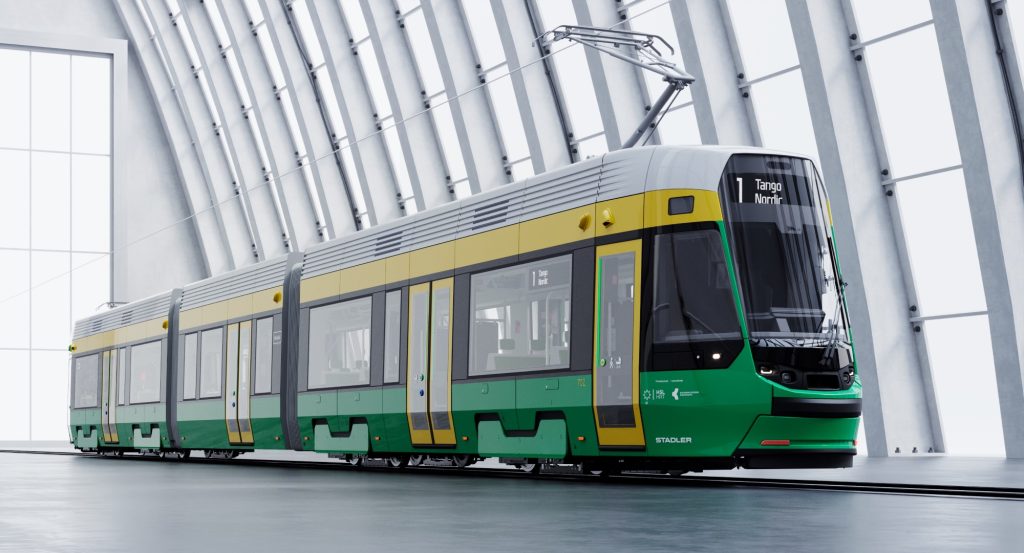
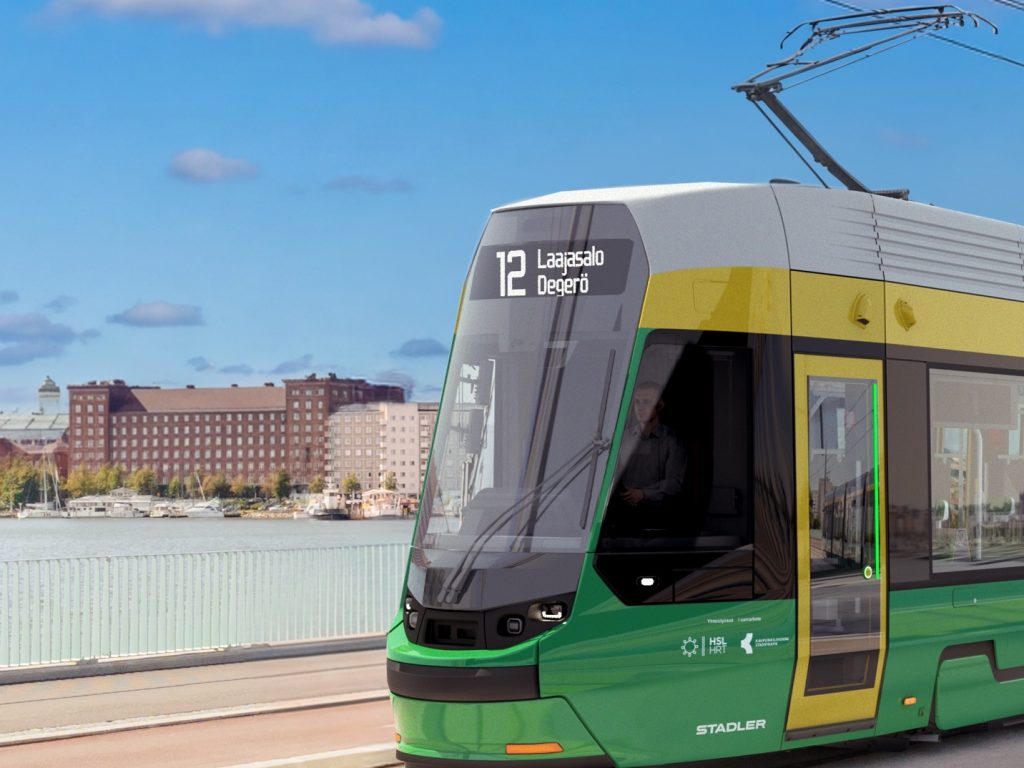 The trams will be based on Stadler’s proven Tango platform, adapted to meet Helsinki’s demanding requirements for operating in extremely cold and icy conditions.
Stadler said the styling has been developed in collaboration with Nordic design studio Aivan to reflect the architectural character and visual identity of the Helsinki region, allowing the new trams to ‘blend harmoniously into the urban landscape’.
The three-section 1 000 mm gauge trams will be between 31 and 34 m in length and 2 400 mm wide, with flexible interior layouts that can be adapted to different operational requirements and passenger needs. Depending on the configuration they will provide between 70 and 90 seats, with two wheelchair spaces and a spacious multifunctional area. The fully low-floor design will provide step-free access throughout the entire length.
The trams will be able to recover braking energy, store it temporarily and reuses it during acceleration to reduce overall energy consumption.
Stadler said particular attention is being paid to the bogies and suspension system. A ‘distinctive technical feature’ will be the four powered and freely pivoting bogies with rigid axles, designed to adapt to the track geometry to ensure smooth operation and reduce wear on the tracks; 40 Adtranz and Bombardier Transportation Variotrams supplied in 1998-2003 were withdrawn in 2018 after encountering problems with Helsinki’s tight curves and challenging operating conditions.
Disputed contract
The procurement process began in 2021 through market dialogue with potential suppliers, and progressed as a negotiated procedure. CAF, Stadler and Škoda Transtech were invited to tender in April 2025, and final bids were submitted by Stadler and Škoda Transtech in July 2025.
Stadler was named the winner that October, with Pääkaupunkiseudun Kaupunkiliikenne saying its bid was the only one that met the 1 600 requirements, which included technical matters, economic factors, environmental impact and the travel experience.
Škoda Transtech, the local subsidiary of the Czech engineering group which has a factory in Finland, then appealed to the commercial court. In March 2026 the court ruled that the company’s bid had not been compliant and so the contracting body was obliged to exclude it. Škoda Transtech then sought leave to appeal to the country’s supreme administrative court, which was denied.
Source: rg