RUSSIA: Moskva’s driverless tram operations are to be expanded to a further two routes by the end of this year, as part of a systematic rollout which aims to have two-thirds of the city’s tram fleet equipped with driverless technology by 2030 and 90% by 2035.
Tram automation
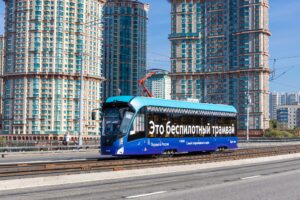
Metro and tram operator Moskva Metro began the regular operation of driverless trams in passenger service on Route 10 from Shchukinskaya metro station to Ul Kulakova in the northwest of the city in September 2025. There are now six driverless trams in service.
Moskva Metro and the Centre for Electric Transport & Driverless Technologies fitted the PK TS 71-911EM Lvyonok single-section trams with six cameras and four lidar and three radar systems. These create a high-precision 3D map of the surroundings for navigation and identifying objects.
The trams autonomously stop in the correct place, open and close the doors, obey traffic lights, give way to pedestrians, independently determine how to cross road junctions, set turnouts and follow the timetable. A member of staff remains onboard to meet federal legal requirements, but the operator says they only observe and do not get involved in operations.
On November 6 Moskva Metro said the hardware and software suite developed entirely in-house has demonstrated the ‘highest level of safety and algorithm reliability’, with the trams having covered more than 72 000 km ‘without a single traffic violation’.
Systematic rollout
A systematic rollout is now underway, with the planned introduction of driverless operation on routes 15 and 21 to take the driverless fleet to 15 trams by the end of 2026. An additional 25 trams are to follow in 2027.
‘Following the instructions of Mayor Sergey Sobyanin, we are continuing to integrate cutting-edge autonomous technology into the capital’s transport system’, said Maksim Liksutov, Deputy Mayor for Transport & Industry.
‘Driverless trams are demonstrating flawless reliability in real-world urban traffic. Scaling this project will significantly enhance schedule adherence, boost average travel speeds, and set new global benchmarks for urban rail transit.’
Source: rg