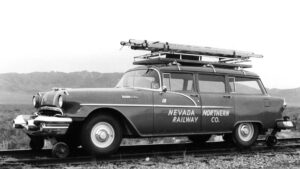
For the past forty years, an intrepid band here in Ely, Nevada has not only preserved the Nevada Northern Railway, but perhaps more importantly, developed it into an economic generator for our community. It hasn’t been easy. We’ve faced—and overcome—countless trials and tribulations. But this is no time to rest on our laurels. Recently, we received two stark wake-up calls in the world of preservation—and unfortunately, both battles were lost.
In Sparks, Nevada, the historic Southern Pacific Machine Shop building was demolished. And on the other side of the country, the iconic S.S. United States ocean liner is now slated to be deliberately sunk. Preservation battles are lost every day—but rarely do we witness two massive defeats in such quick succession.
Let’s start with Sparks. The city was founded in 1904 by the Southern Pacific Railroad as a major repair and switching hub, after a fire and track realignment prompted the relocation of operations from Wadsworth. On July 1 of that year, the entire town of Wadsworth quite literally moved: houses were dismantled and placed on flatcars, trees were dug up for transport, and families migrated to the new site, which would eventually be named Sparks after Governor John Sparks, who threw a celebratory barbecue at his Alamo Ranch.

The Sparks Machine Shop coming down. Photo by Michelle Renee Dumont
The Machine Shop building in Sparks was one of the largest structures on the new complex. Inside, you’d find all the tooling needed to keep Southern Pacific’s steam locomotives—including their legendary cab-forwards—up and running. It was the last surviving structure of the Sparks hub, the principal repair facility between Sacramento and Salt Lake City. And now, it’s gone.
Kudos to the City of Sparks for trying to save it. But with its destruction, the railyard’s historic footprint has been permanently erased. The city and Union Pacific offered bricks from the building to the public as souvenirs—but a brick with no context is just that: a brick.
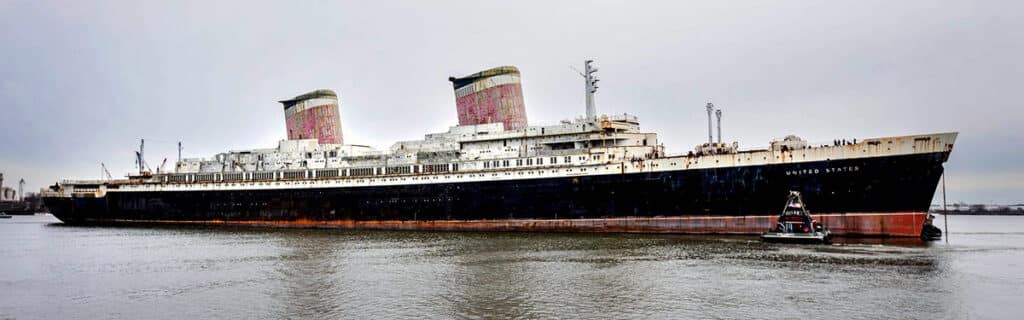
The S.S. United States soon to become the world’s largest artificial reef in Destin-Fort Walton Beach, Florida.
Then there’s the S.S. United States. Built in 1950–51, she was the largest ocean liner constructed entirely in the U.S. and the fastest to ever cross the Atlantic—a record she still holds today. She represented the very best of American engineering and spirit. Sadly, after years of languishing at a Philadelphia pier under nonprofit ownership, she was evicted in 2024 due to a rent dispute. Now, with no other home, she has been purchased by Okaloosa County, Florida, which plans to sink her by 2026 to create the world’s largest artificial reef. A symbol of U.S. pride and achievement—soon to become a fish habitat. Tragic.
I’ve had my own brush with loss. Years ago, Joan and I passed through Carson City on the way home from a trip to California. There stood the Virginia & Truckee Railroad engine house—a magnificent granite structure, in my opinion one of the most interesting buildings ever constructed in Nevada. But I was tired, the light was fading, and I figured I’d take pictures next time. (This was before cell phones.) Except… there wasn’t a next time. The engine house is gone.
After twelve years of effort, to make it a Nevada State Park, the building was sold, disassembled, and reassembled—in California—at a winery. Another irreplaceable piece of Nevada’s rail heritage lost.
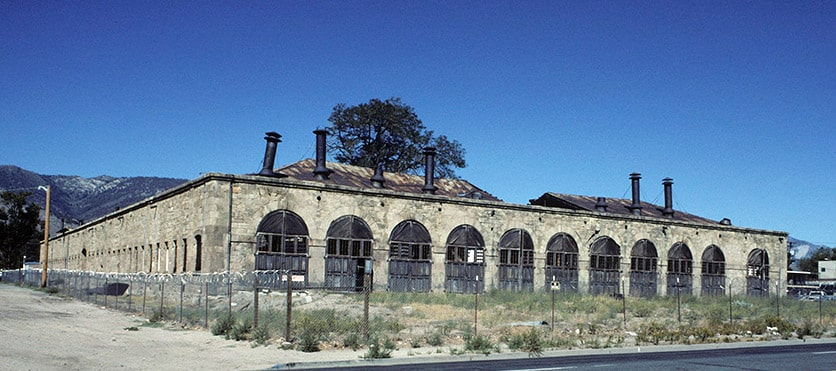
The V & T Engine House shortly before demolition. Photo by Dave Maffei
Here’s the tie to us: When Kennecott generously gave the Nevada Northern Railway to the City and Foundation, they didn’t include any funds for restoration. So, we approached Nevada State Parks about turning the railroad into a State Park. They conducted a feasibility study. Short version? It would take millions. And after their experience with the V&T engine house, State Parks knew the legislature wouldn’t back another big preservation effort. They were right.
Yet despite all this—here we are, celebrating our 40th year!
In that time, we’ve restored nine original buildings, returned three out of four original steam locomotives to service, rebuilt track and crossings, overhauled utility systems, and preserved the written record of this incredible railroad. But again, this is no time to sit back.
We’re stilling facing major challenges.

Perhaps the biggest challenge facing us is the pump storage project that is planned to be built next to and between two branches of the railroad between Ely and McGill.
This has been a long, costly fight that is burning through a lot of time and money. If the project goes through, its planned seven-yearconstruction period is no small threat. would have a major negative impact on the railroad and might threaten our very existence. Operating excursion trains through a site that will be under construction for seven years will severely impact our operations, ridership, and revenue. It’s a preservation fight we must win.
We’re making progress on the SNPLMA grant to reopen the line to McGill, in partnership with White Pine County and the BLM. We’re not in the driver’s seat—but we’re in the car, making suggestions.
On the building front, we’ve secured two grants. Yay! One for the Air Brake Building and another for the former Kennecott headquarters in McGill. The Air Brake grant will restore the building and return it to use. The McGill grant will allow us to plan its restoration and determine a future purpose.
Then there are our steam locomotives. When you run equipment that’s over 100 years old, things break.
Locomotive 81’s pilot truck turned into a bigger project than expected—but Ken has made remarkable progress. She should be steaming this summer. Ken and DJ’s article, In the Pits with Ken, tells the full story.
Thursday, May 8th is a case study in why preservation is HARD. The day started well. Ian Grant, Executive Producer of Culture Quest on PBS, visited to film an episode on the railroad. Using the Doodlebug, we took him to Keystone to share the history of the railroad and the people who built and ran it. Everything went smoothly.
But then, trouble.
Bill, the Doodlebug operator, spotted a chunk of metal next to the track. After putting the Doodlebug away, he brought it to John Henry, our Master Mechanic. Turns out, it was part of the hub liner from the engineer’s side of axle 4. This liner protects the driver and the drivebox holding the crown brass.
John Henry initially hoped we could replace it without dropping the axle. Nope. Down it came—thanks to our 1907 machine shop, we had the tools to do it.
But once the axle hit the shop floor, we found more problems.
The drivebox on the fireman’s side wouldn’t budge. When it finally came off, disaster: the axle had a burn mark from overheating, and the crown brass was scorched. Repairable, yes—but it means Locomotive 93 will be out of service for possibly six weeks—right at the start of tourist season!
That’s what happens when you’re committed to keeping 116-, 115-, and 108-year-old steam locomotives running.
Thanks to our incredible staff, volunteers, and members, both Locomotive 93 and 81 will return to operation this June. Locomotive 40 will take a bit longer—but when she rolls out, she’ll be better than when she left Baldwin in 1910. And we’ll have three operating steam locomotives!

Hub liner next to the rail found by Bill.
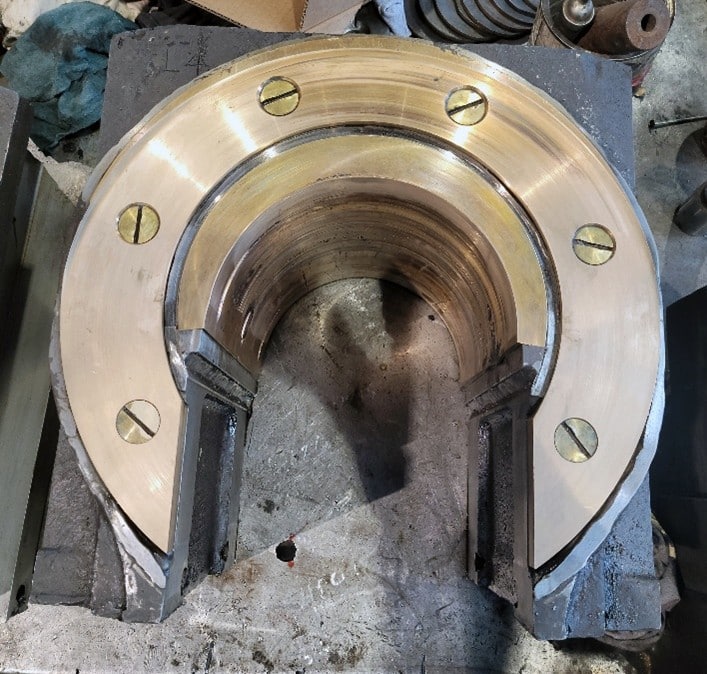
The drive box removed from the axle.
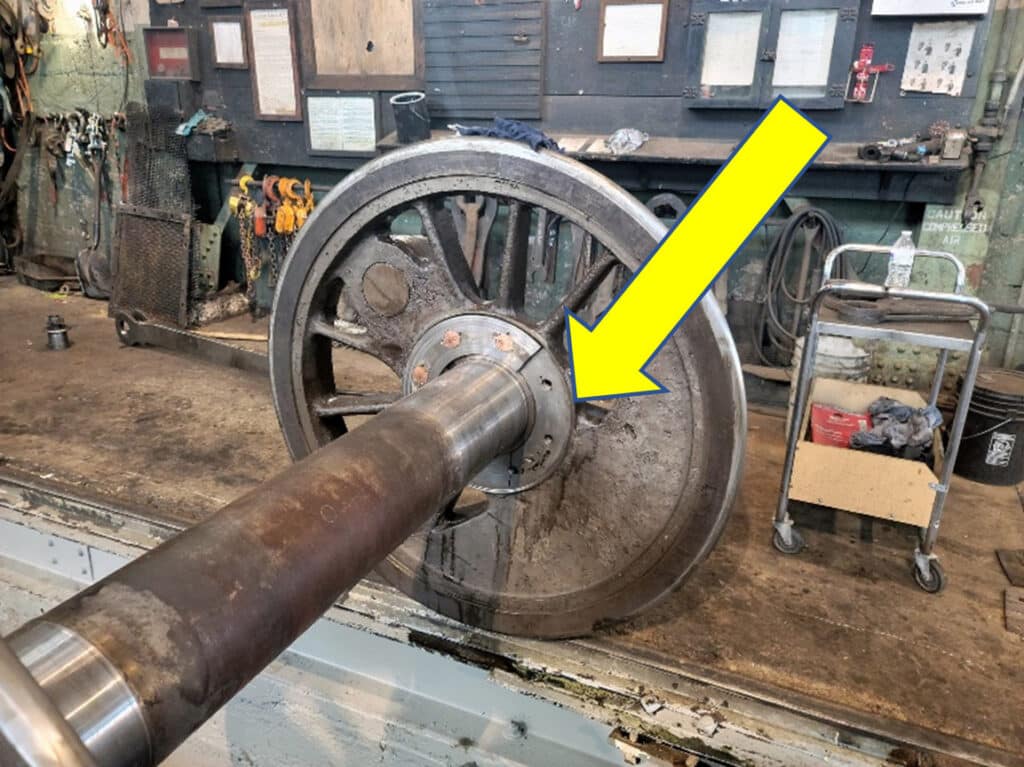
The arrow points to the missing hubliner
Thanks to our incredible staff, volunteers, and members, both Locomotive 93 and 81 will return to operation this June. Locomotive 40 will take a bit longer—but when she rolls out, she’ll be better than when she left Baldwin in 1910. And we’ll have three operating steam locomotives!
Here, in the most remote city in the lower 48, we’ve made extraordinary progress preserving this National Historic Landmark. But preservation doesn’t just happen. It’s HARD. Most of the time, it feels like three steps forward and two back—but that still counts as forward.
It’s thanks to a small, dedicated staff, extraordinary volunteers, and a passionate army of members. Yes, it’s HARD—but we do it because we believe it’s necessary. And that belief is what preserves this incredible piece of American history.
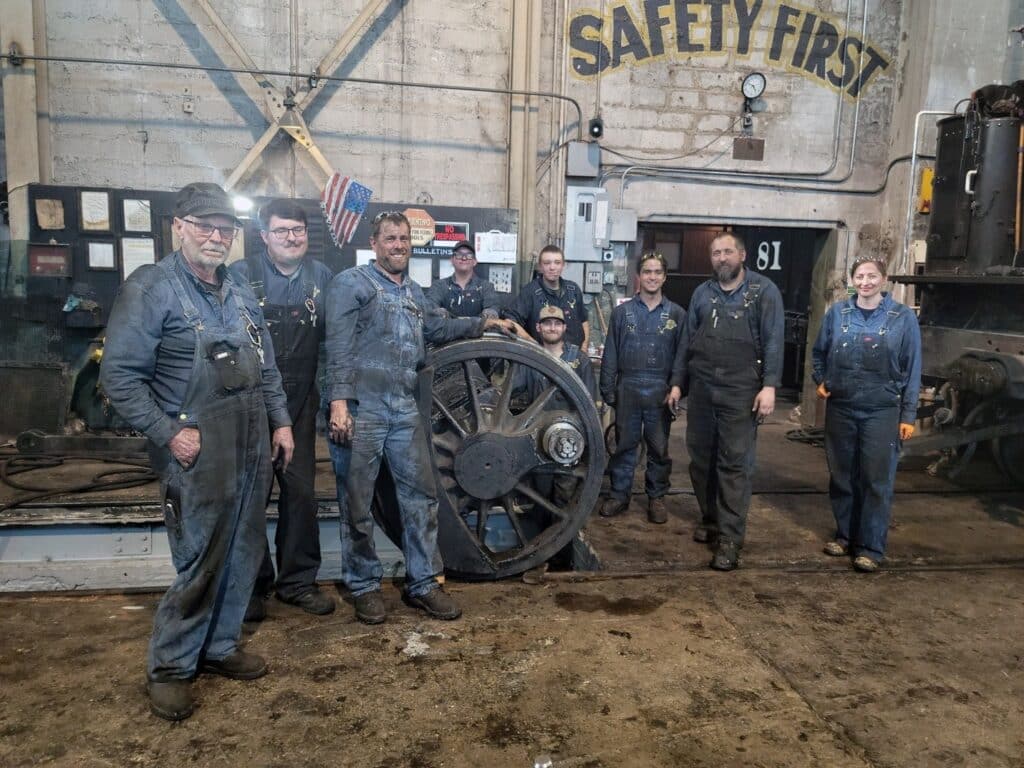
Part of our incredible staff and volunteers (from left to right) Gary, Brandon, Bill, Chris, Tristin (with hat), Jake, Arthur, Vince and Kathleen. They’re the crew that dropped the axle.
Source: Nevada Northern Railway