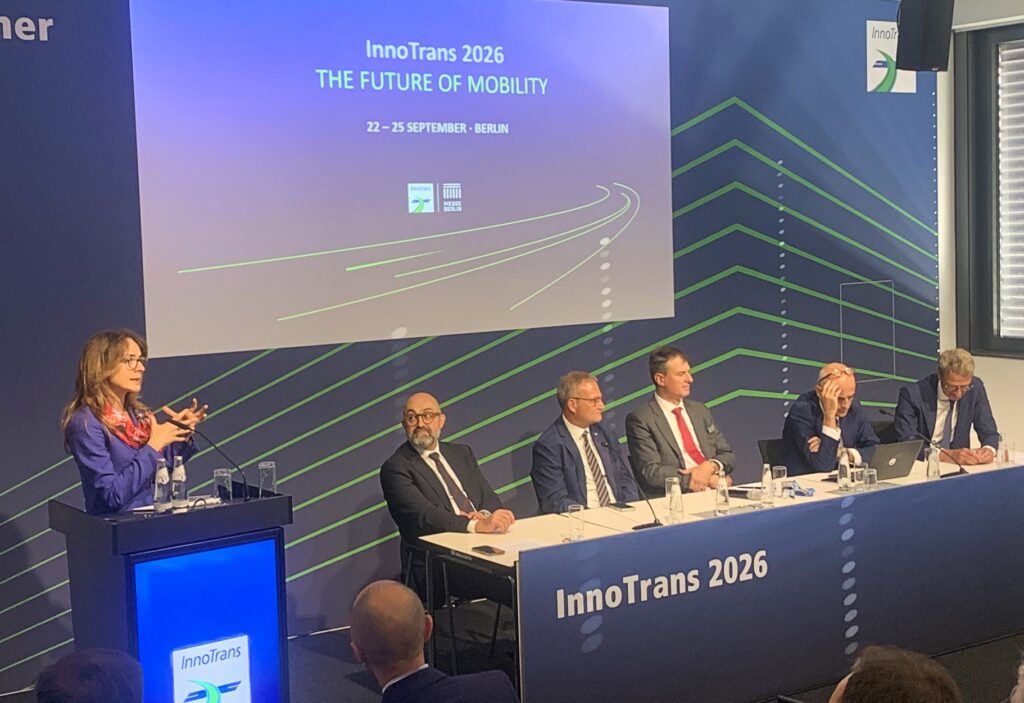
INNOTRANS: One year after Europe launched its high speed rail action plan, industry leaders at InnoTrans 2026 said demand and investment are not the main barriers to expansion; from certification and testing capacity to fragmented standards and network access, uncertainty remains the key constraint. ‘We can find the money’, said FS International CEO Luigi Corradi: ‘The problem is to make sure that this investment is stable.’
The European Commission launched its high speed rail action plan late last year, targeting a faster, more integrated network by 2040 as part of its push for what it calls ‘a genuine single EU transport market’. The scale is considerable: completing the planned TEN-T high speed network alone is estimated to require around €345bn in infrastructure investment. With the Commission seeking binding timelines for tackling cross-border bottlenecks by 2027, the plan spans everything from track access, rolling stock approvals, ticketing and ERTMS to mobilising the private capital needed to turn ambition into reality.
During the ‘High speed rail plan – one year on’ discussion at InnoTrans 2026, many of the barriers that once complicated cross-border high speed rail were presented as solvable. ‘All the technological issues, those challenges are over’, said Pedro Marco de la Peña, Chairman of Spain’s infrastructure manager ADIF. Speaking as a representative of one of Europe’s clearest examples of rapid high speed rail expansion, he argued instead that the missing ingredient was ‘commitment, real commitment from the countries’, backed by stronger EU supervision and binding requirements.
‘You have a lot of excuses to do nothing. A lot’, he added. ‘But all the arguments are over. You just have to do it.’
‘In the Kalahari’
Spain’s own experience underpins de la Peña’s argument. ‘It’s true that we have developed in a very short period of time a huge high speed network,’ he said. ‘My country is a demonstration that when you want to, you can.’ The same applies to the signalling technology meant to make cross-border operation easier: Spain has more than 3 000 route-km of ERTMS in operation, which ADIF reports as Europe’s largest deployment.
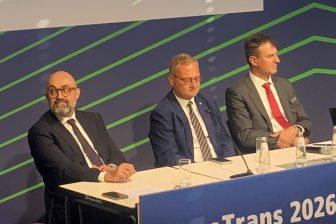
For de la Peña, that left increasingly little room to blame the old technical barriers to cross-border operation. ‘All the issues about different gauges are over, it’s solved’, he said, making the same point about differences in electrical systems and regulation. The problem, he argued, becomes much more obvious once the network reaches the frontier. ‘You arrive at the border and it seems that you are in the Kalahari.’
To the north, he said, Spanish high speed infrastructure meets a French network where conventional lines offer less capacity than would be needed for the envisaged European network. ‘So for me, the solution is commitment, real commitment from the countries. Real supervision which is mandatory, from the EU: you need to do that’, he said, nodding towards the ERA and European Commission representatives on the panel.
Towards a single European strategy
Even where ERTMS has been deployed, FS International’s Corradi said national implementations can still leave international trains having to carry multiple systems. ‘There is ERTMS in France? Yes. There is ERTMS in Italy? Yes’, he said. ‘I have four signalling systems in the train. I have the different version of ERTMS between France and Italy. This is the real situation today.’
EU high speed rail action plan at a glance
- Launched: 5 November 2025; EU high-speed network targeted for 2040
- Bottlenecks: binding cross-border deadlines to be set by 2027
- Funding: EU financing strategy plus a proposed High Speed Rail Deal
- Market access: fairer track charges, better capacity allocation and easier entry
- Rolling stock: 2027 measures for resale and against anticompetitive scrapping
- Ticketing: 2026 proposal for easier cross-border booking
- ERTMS: harmonised European deployment plan due in 2026
- Technical approvals: ERA mandate to be revised in 2026 to simplify vehicle and infrastructure authorisation
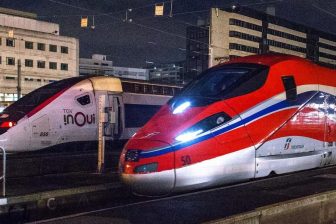
FS has nevertheless gone some way towards turning national operations into one European service. Its international passenger business already generates around €3bn across six European markets, with high speed operations established in France and Spain, and further expansion planned into Germany, Austria, Belgium and the UK.
Corradi said FS International had been created to move beyond expanding ‘piece by piece and opportunity by opportunity’ and bring those operations under a single European strategy, a ‘Metro of Europe’, with the same service proposition and simpler ticketing across borders. Demand, he argued, was already there. When FS launched Milano – Paris, Corradi recalled questioning whether passengers would spend around 7 h 30 min on the train. ‘The answer was yes’, he said, with the service now recording an average load factor of 83%.
The problem of homologation
What has proved harder is getting the Hitachi-built Frecciarossa 1000 approved across Europe. The train was designed for operation across seven European networks, but 16 years after the first order in 2010, Corradi said FS was still struggling to complete all the necessary tasks. Certification in a single country, he added, can cost more than €10m.
‘Stability is what we need’, he stated. ‘Money is never the problem, we can find the money — there are a lot of people that want to invest in trains.’ The harder question was what that investment could rely on once committed. ‘If we buy the train, we have to be sure we can have the network then’, Corradi said, ‘because there is a risk that we put a lot of money into the train and then don’t have the network we need’.
If that uncertainty remains a problem for an established state-backed operator such as FS, it can hit even harder for new entrants dependent on private capital. Laurent Fourtune, Founder & CEO of French newcomer Kevin Speed, said investors wanted to know when a train would be certified; once route compatibility was included, the answer could be ‘anywhere between eight months and eight years’.
‘This is a killer for private investment’, Fourtune said. ‘There will not be any private investment if there is no reliability, stability in the way we can homologate. This is the key, it’s not even the cost.’ He suggested governments could share some of that certification risk, citing the repayable launch investment used for the Airbus A320, where public money was recovered through royalties. ‘The key question is how can you share this risk to everybody’, he said.
Manufacturers are also facing the same need for certainty. Alstom European Affairs Director Nicolas Erb pointed to around €150m invested in additional high speed production capacity, while warning that European testing remained ‘extremely burdensome and time consuming’. ‘As a supplier you need to have confidence that the market is there’, he said. ‘You need to have a good visibility on what are the needs that are coming.’
Freeze the specifications
Those complaints fed directly into the commitments set out by ERA Executive Director Oana Gherghinescu at the end of the discussion. Her first was to support greater standardisation and scale in high speed rail; the second was to stabilise technical specifications; ‘freeze them and allow breathing space for all of you here’, she said, ‘but also for investors, because they want to see stability when they put their money in’.
The third was to accompany ERTMS deployment more closely so Europe did not continue accumulating what she called ‘the accents, the dialects, the versions and the variants’. In return, Gherghinescu said ERA expected industry to rely far more on standardised platform trains rather than national customisation. ‘No tailored requirements’, she said, joking that the only thing operators should still get to change was the ‘colour of the seats’.
Back to the passenger
For Magda Kopczyńska, head of the Commission’s transport directorate DG Move, the debate ultimately came back to why the high speed rail plan was conceived in the first place. ‘This whole idea came from very specific, very personal user experience’, she said. ‘Why can’t we in the EU be at the level that is there in other parts of the world?’
The Commission estimates that €354bn to €540bn could be needed by 2040, although Kopczyńska joked that she was ‘a bit reluctant’ to ask whether those figures were still standing ‘or they are 20% higher’. A financing strategy is now being developed with member states, operators and private financial institutions, she said.
But money was only one part of her answer. Infrastructure has to be built, industry needs sufficient scale, passengers need genuine choice and the network has to operate as an internal market rather than a collection of national systems. ‘It has to be one high speed rail network that works according to the same set of specifications’, Kopczyńska said, ‘because otherwise we’ll never get the scale that is needed to make that high speed rail work’.
Source: rg