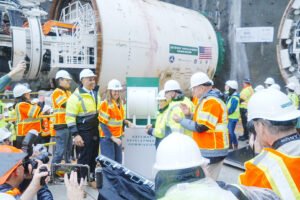
USA: The Gateway Development Commission held a celebration at Tonnelle Avenue in North Bergen on September 29 to mark the start of boring work for the Hudson Tunnel project to excavate a second pair of railway tunnels between New York and New Jersey.
Final testing of the first tunnel boring machine is expected to be completed in the next few days, after which it will start work. A second machine is scheduled to follow shortly afterwards.
‘This historic moment marks the start of the first phase of tunnel boring for the Hudson Tunnel Project — the first new rail tunnel under the river in more than 100 years’, said GDC Chief Executive Officer Tom Prendergast. ‘We would not be here today without the hundreds of people who have poured countless hours into planning, designing, and building this project. In the days, months, and years ahead, we will continue to build on their hard work to deliver this critical project for the riders who are counting on us today, and the future riders who will use the tunnel for decades to come.’
The twin-bore tunnels are intended to increase capacity on Amtrak’s Northeast Corridor, freeing up the 1910-built Hudson Tubes for much-needed repairs to the floodwater damage incurred during Superstorm Sandy in 2012. They will carry inter-city trains as well as NJ Transit commuter rail services to and from the New York metropolitan area.
Construction packages
The project is being delivered through 10 construction packages. The first of these was completed in early 2026, and six more are currently in progress. The first phase of tunnel boring is being undertaken by the Schiavone Lane Dragados joint venture as part of the Palisades Tunnel Project package. Project management for this section is being provided by the Port Authority of New York & New Jersey, which has contributed $2.7bn to the Gateway project.
The two hard-rock TBMs will bore around 1.5 km of tunnel through the hard rock under the Palisades Cliffs in New Jersey as far as the Hudson County Access Shaft on the border of Weehawken and Hoboken. Advancing at around 10 m per day, they are expected to take a year to complete the task.
The single shield machines have an 8.7 m diameter cutterhead, and the completed tunnels will have an internal diameter of 7.7 m. Including the 150 m long trailing gantry, each TBM weighs around 1 525 tonnes.
After the TBMs have been removed from the access shaft, they will be replaced by a second pair of machines optimised to bore the section of the tunnel under the Hudson River where the geology is different.

Strong support
‘I spent years in Congress fighting for the Hudson Tunnel Project because it is the most important infrastructure project in the country’, said New Jersey Governor Mikie Sherrill. ‘I was proud to be called the ‘tunnel-obsessed Congresswoman, and as Governor I will keep fighting until this tunnel is built, so 100 000 jobs will be delivered, and millions of New Jersey commuters and travellers finally have the reliable service they deserve.’
New York Governor Kathy Hochul said ‘building a new rail connection across the Hudson River has been a dream for over a generation. We fought and beat efforts from the Trump administration to halt the Gateway project, and today that dream becomes a reality. This is a historic day for New York and a clear demonstration of our ambitions to once again dream and build big.’
Amtrak’s GDC Commissioner and Vice-Chair Tony Coscia pointed out that ‘the Hudson Tunnel Project is far more than a New York-New Jersey project, it is a critical investment in America. The Northeast Corridor is the busiest passenger rail line in the country, and right now it depends on a tunnel that was built by hand a decade before the first commercial radio broadcast. The tunnel boring machines launching today prove how far we have come since then, and building this tunnel will show the world that America can still build big things. This is a historic moment, and a statement about what our nation can accomplish.’
Source: rg