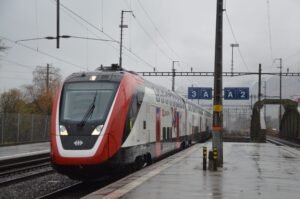
SWITZERLAND: SBB has put the first rebuilt FV-Dosto double-deck train into regular passenger service, following approval from rail safety regulator BAV. The double-deck Bombardier Twindexx EMU re-entered service on September 30, marking the first deployment of an FV-Dosto equipped with modified bogies without the WAKO passive tilt mechanism.
The modifications to the fleet are intended to improve ride comfort while reducing long-term maintenance costs. Removing the maintenance-intensive WAKO system simplifies the bogie function, reducing depot work and the risk of technical failures. SBB expects the modification programme to generate around SFr40m in savings over the fleet’s lifetime.
The modification of the entire FV-Dosto fleet will be carried out progressively in Switzerland during scheduled overhauls. SBB plans to complete the work in the early 2030s. The operating approval for the modified trains was granted by BAV at the end of August.
The FV-Dosto fleet comprises 62 trainsets, originally equipped with WAKO, a passive roll-compensation system designed to reduce the lateral acceleration perceived by passengers and allow faster running through curves. Unlike active body tilt systems deployed on fleets such as SBB’s Alstom Pendolinos, WAKO used the kinematics of the bogie and suspension, without motors or hydraulic actuators, to induce a controlled inward roll of the carbody. As the bogie entered a curve and lateral wheel-rail forces increased, specially designed suspension and kinematic elements caused controlled lateral movement between the bogie and carbody.
The resulting inward roll altered the carbody’s orientation relative to the combined forces of gravity and lateral acceleration. This was intended to support faster curve running without requiring major increases in track cant.
In service, however, the interaction between the WAKO system, bogie and suspension resulted in excessive rolling, jolting and vibration. The effects were particularly noticeable on curves, through pointwork and when passing over worn track, while wheelset wear could further aggravate the problem. Track flaws were transmitted too strongly to the carbody, undermining the intended comfort benefits.
SBB decided in 2022 to abandon the WAKO functionality, and it worked with OEM Alstom, as successor to Bombardier Transportation, the manufacturer of the trains, to develop an optimised bogie without the passive tilt capability, with prototype development beginning in 2023.
The modified bogie was tested at Velim in the Czech Republic and subsequently on the Swiss network during 2025, with test passengers reporting reduced vibration and improved ride comfort. On December 5 2025, SBB approved modification of all 62 FV-Dosto trainsets.
A difficult procurement
SBB awarded Bombardier the contract for the fleet of double deck trains on May 12 2010, following a 2009 tender. The order was worth approximately SFr1.9bn, making it at the time SBB’s largest-ever rolling-stock procurement. The original order was for 59 trainsets, with delivery planned for 2013-19 comprising four batches of EMUs in a mix of inter-city and regional express layouts and four- and eight–car formations. All were designed for 200 km/h operation and could be coupled to form trains of up to 400 m in length.
The procurement proved challenging from the outset, especially after disability organisations challenged aspects of the train’s design, including wheelchair facilities. This led to a lengthy legal dispute and substantial redesign work. The restaurant car also had to be modified to incorporate a PRM-compliant accessible toilet.
The result was repeated delays to the trains’ introduction, with the first fare-paying passengers being carried in February 2018, more than four years later than originally envisaged. The order was also increased from 59 to 62 trainsets, after Bombardier compensated SBB for the delays by supplying three additional complete trainsets at no extra cost.
Source: rg